 WhatsApp: +86 18020776782
 Time: 24/7/365 Support

Hot Categories
Woodward 9905-792 Troubleshooting Guide for ProAct Speed Control2026-08-28
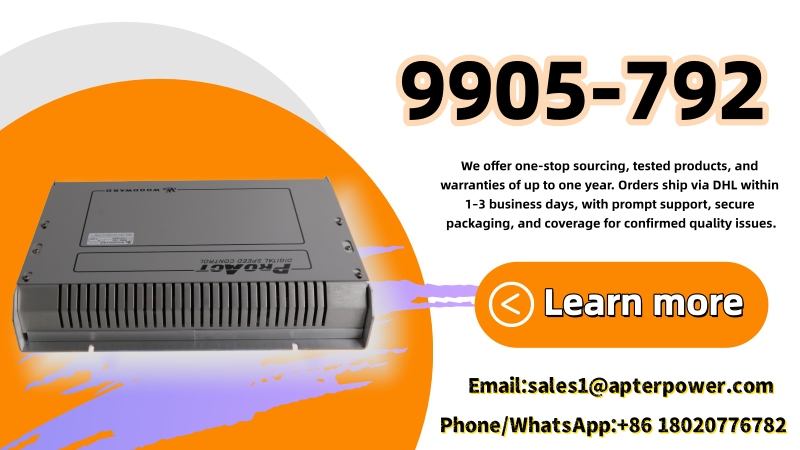
The Woodward 9905-792 ProAct Digital Speed Control is an electronic engine governor used in mechanical-drive engine and generator-set applications. It receives engine-speed feedback from a magnetic pickup, compares the actual RPM with the configured speed reference, and sends control commands to a compatible ProAct electric actuator. The actuator then adjusts fuel delivery to maintain stable engine speed during startup, normal operation, and load changes.
When an engine experiences speed hunting, unstable RPM, startup failure, no actuator movement, speed loss under load, poor load response, or incorrect fuel limiting, maintenance personnel may immediately suspect a failed Woodward 9905-792 controller. In practice, many apparent Woodward speed controller faults originate from an unstable power supply, weak magnetic-pickup signal, damaged ProAct actuator, binding mechanical linkage, incorrect 4–20 mA fuel-limit signal, or unsuitable governor settings.Effective Woodward 9905-792 troubleshooting should therefore examine the complete ProAct engine speed-control system rather than the controller alone. The following six sections explain how to diagnose common Woodward 9905-792 faults, check the ProAct actuator and 4–20 mA fuel limiter, review the controller configuration, and determine whether a Woodward 9905-792 repair or replacement is necessary.
1. Check the Control Power and Grounding
The first step in troubleshooting a Woodward 9905-792 is to inspect the DC power supplied to the controller and ProAct actuator. Low voltage, voltage drops during actuator movement, excessive ripple, poor fuse connections, or loose terminals may cause the controller to restart, the actuator to respond slowly, or the engine speed to become unstable.
Do not rely only on the nominal voltage printed on the power-supply label. Measure the actual voltage at the control terminals while the controller is powered and while the actuator is moving. Confirm the acceptable range using the documentation for the installed control and actuator.
Power polarity, grounding, terminal condition, and cable voltage drop should also be inspected. If the problem occurs only during engine startup, a sudden load change, or fast actuator movement, monitor the supply voltage under those exact conditions.
A stable power source and correct grounding are essential before any other ProAct Digital Speed Control diagnostics can produce reliable results.
2. Inspect the Magnetic Speed-Sensor Signal
The Woodward 9905-792 requires a reliable engine-speed feedback signal. If the magnetic pickup does not produce a stable signal, the controller may fail to detect engine speed or may send unstable commands to the actuator.
Check the sensor gap, gear-tooth condition, cable continuity, terminal connections, shielding, and cable routing. A sensor positioned too far from the gear, damaged gear teeth, a broken cable, or interference from ignition and high-current wiring can weaken or distort the speed signal.
The signal should be checked during cranking, startup, and normal operation whenever practical. Comparing these conditions can help identify an intermittent magnetic-pickup problem.
If the controller does not detect speed or the reported engine speed changes unexpectedly, inspect the magnetic pickup and its wiring before ordering a Woodward 9905-792 replacement. Replacing the controller will not correct a missing or unstable speed signal caused by an external component.
3. Examine the ProAct Actuator and Mechanical Linkage
During Woodward 9905-792 troubleshooting, a normal controller output does not guarantee that the fuel mechanism is responding correctly. A defective ProAct actuator, damaged actuator wiring, incorrect rotation, or binding mechanical linkage may prevent the engine from accelerating, cause continuous speed oscillation, or produce an unstable fuel response.
After shutting down the engine and completing the required isolation procedures, check the ProAct actuator model, part number, power supply, wiring, rotation direction, and operating travel. The fuel rack, butterfly valve, and connecting linkage should move freely without looseness, excessive friction, mechanical interference, or contact with an unintended travel limit.
If the actuator has recently been replaced, confirm that the new unit is compatible with the installed Woodward 9905-792 ProAct Digital Speed Control. ProAct actuators from different generations should not be combined with an existing controller simply because the electrical connectors, mounting points, or physical dimensions appear similar.
A mismatch between the Woodward speed controller and ProAct actuator may cause engine-control problems that cannot be corrected through gain, stability, or speed-setting adjustments. Before ordering a ProAct actuator or Woodward 9905-792 replacement, verify compatibility through the applicable Woodward manual, engine-manufacturer records, or a qualified governor-control service provider.
4. Test the Woodward 9905-792 4–20 mA Fuel-Limit Signal
The Woodward 9905-792 includes a 4–20 mA fuel-limit input that allows an external device to restrict fuel demand according to engine operating conditions. If the signal is too low, incorrectly polarized, interrupted, unstable, or improperly scaled, the engine may fail to reach rated speed or accept its normal generator load.
When checking the Woodward 9905-792 fuel limiter, measure the actual loop current and compare it with the external device output and current operating condition. Verify the signal direction, terminal polarity, shielding, grounding, loop power, and wiring against the approved Woodward diagram and engine-control design.
If the engine runs normally without load but cannot increase fuel after loading, the 4–20 mA fuel-limit circuit should receive particular attention. The external command may be restricting ProAct actuator demand even when the Woodward digital speed controller and actuator are operating correctly.
Do not short the terminals or force a higher current simply to bypass the fuel limit. Incorrect testing could expose the engine to excessive fuel, overload, or overspeed. All 4–20 mA fuel-limit troubleshooting should follow the engine manufacturer’s instructions and the site’s approved commissioning and safety procedures.
5. Review the Woodward 9905-792 Settings and Configuration
Incorrect gain, stability, rated-speed, actuator-direction, acceleration, or fuel-limit settings may create apparent Woodward governor control faults. Common symptoms include repeated engine-speed hunting, slow recovery after a load change, excessive acceleration, poor load response, or actuator movement in the wrong direction.
Before changing any Woodward 9905-792 parameter, back up the existing configuration and compare it with the original commissioning records. Do not copy settings from another generator simply because it uses the same Woodward 9905-792 speed controller. Differences in engine type, fuel system, generator rating, ProAct actuator size, linkage geometry, and operating duty may require different control settings.
When selecting a Woodward service tool or control configuration file, verify the complete part number and revision printed on the controller nameplate. Woodward recommends identifying the correct unit part number and revision and cross-checking these details before installing configuration files. Woodward control configuration guidance
Parameter changes should only be performed by qualified personnel and documented through the plant’s management-of-change process. Adjusting gain, stability, or fuel-limit settings without identifying the original fault can make the engine less stable, increase troubleshooting time, and lead to an unnecessary Woodward 9905-792 repair or replacement.
6. Decide Whether the Controller Requires Repair or Replacement
A Woodward 9905-792 repair or replacement should be considered after the power supply, speed signal, actuator, mechanical linkage, 4–20 mA loop, and control settings have been checked.
When sourcing another controller, provide clear photographs of the complete nameplate, including the part number, revision, and serial number. The inquiry should also include the actuator model, system voltage, engine application, required quantity, and destination.
Woodward 9905-792 controllers may be offered as factory-new, unused surplus, repaired, refurbished, or used equipment. Price alone does not establish condition, compatibility, or reliability.
Before purchasing, ask about the repair history, testing procedure, warranty period, storage conditions, delivery time, and return policy. A simple power-up test does not prove that the controller can process a speed signal, command a ProAct actuator, and respond correctly to a 4–20 mA fuel-limit input.
After installation, commissioning should verify speed detection, actuator direction, minimum and maximum fuel positions, idle and rated speed, 4–20 mA fuel limiting, speed stability, load response, shutdown operation, and protection functions.
The engine or generator set should only return to normal service after the replacement controller has passed the site’s approved functional tests.
Conclusion
When performing Woodward 9905-792 troubleshooting, the controller should be treated as one part of a complete ProAct speed-control system rather than as an isolated electronic module. The control power, magnetic speed sensor, ProAct actuator, mechanical linkage, 4–20 mA fuel-limit signal, and controller configuration can all affect engine-speed performance.
Following these six troubleshooting steps can help maintenance teams distinguish between external wiring faults, configuration problems, actuator issues, and controller hardware failures. A systematic approach reduces unnecessary controller replacements, repeated troubleshooting, and avoidable generator downtime.
With more than ten years of industry experience, extensive inventory, and a professional team, we serve every customer with sincerity. Contact us for Woodward 9905-792 availability, pricing, repair, and replacement support.
Sales manager:Jim Pei
Wechat: ZXH18020776782
Phone/WhatsApp:+86 18020776782
- Contact Us
-
Who are we?
ARWELL is a global supplier of PLC, DCS, VFD, HMI and other industrial automation components.We provide industrial automation parts and sourcing solutions for a wide range of applications.
 ZXH18020776782
 sales1@apterpower.com

Copyright © 2024 ARWELL LIMITED
Disclaimer: ARWELL sells new and surplus products and develops channels for purchasing such products. This website has not been approved or recognized by any of the listed manufacturers or trademarks.
ARWELL is not an authorized distributor, dealer, or representative of the products displayed on this website. All product names, trademarks, brands, and logos used on this website are the property of their respective owners. The description, explanation, or sale of products with these names, trademarks, brands, and logos is for identification purposes only and is not intended to indicate any association with or authorization from any rights holder.