 WhatsApp: +86 18020776782
 Time: 24/7/365 Support

Hot Categories
Why is the GE IS420ESWBH3A still suitable for the Mark VIe control network, despite lacking fiber-optic ports?2026-11-03
The GE IS420ESWBH3A is an ESWB-type IONet switch from the Mark VIe series. It is equipped with 16 copper 10/100Base-TX RJ-45 ports and does not feature any fiber-optic ports. GE Vernova's official documentation lists it as the Mark VIe IONet Switch and explicitly states that it is a product configuration without fiber optic ports.
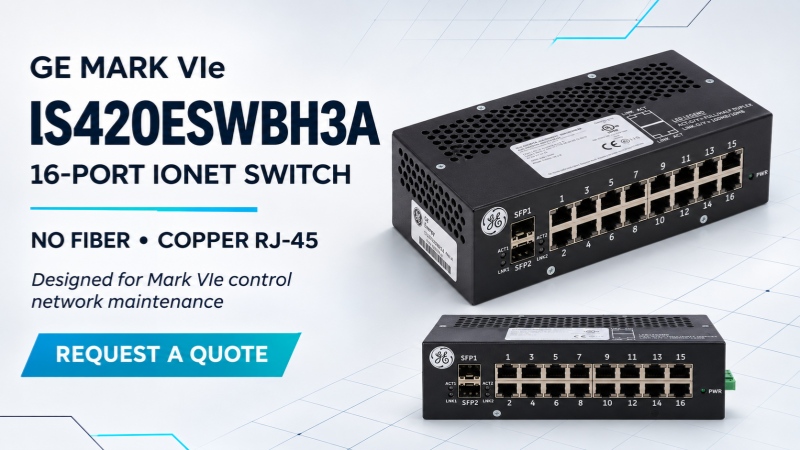
Product Positioning of the IS420ESWBH3A
The IS420ESWBH3A is designed primarily for IONet network connectivity within Mark VIe and Mark VIeS control systems. It is not a general-purpose switch intended for standard office networks; rather, it is a specialized device for industrial control system networks.Key specifications for this model include:
- 16 copper 10/100Base-TX ports;
- RJ-45 interfaces;
- Compatibility with Cat 5e UTP copper cabling;
- No fiber-optic ports;
- 24/28 V DC power supply;
- Support for dual independent power inputs;
- Diode-OR redundant power configuration;
- Natural convection cooling;
- DIN-rail mounting capability;
- An operating temperature range of -40°C to 70°C.
Official specification sheets indicate that the unit measures approximately 18.8 × 8.6 × 5.6 cm. Installation requires selecting the appropriate DIN-rail mounting clip based on the specific hardware form factor and mounting orientation.
Why is it still suitable for the Mark VIe despite the lack of fiber-optic ports?
The Mark VIe control system does not require every IONet switch to use fiber optic cables. Whether fiber optic cables are needed depends on the distance between control cabinets, the on-site electromagnetic environment, network topology, and system design.If the field devices are located in the same control cabinet or adjacent cabinets, copper RJ-45 connections are usually sufficient to meet the network deployment requirements. In this situation, fiber optic ports are not only not necessary, but may also increase the complexity of fiber optic transceivers, patch cords, termination, and maintenance.
The IS420ESWBH3A's advantage lies in providing 16 copper ports, making it suitable for connecting multiple Mark VIe network nodes, I/O devices, or network branches within a control cabinet. When the original system already uses Cat 5e copper cabling, using the fiber-free version can reduce the amount of rewiring work and make it easier to maintain the original network structure.
In other words, the "no fiber" designation of the IS420ESWBH3A is not a lack of functionality, but rather an explicit configuration for copper-based Mark VIe networks.
How does it differ from other ESWB models?
All models in the IS420ESWBH series feature 16 10/100Base-TX copper ports, but they differ in their fiber-optic configurations.The IS420ESWBH1A is equipped with one 100Base-FX multimode fiber port, while the IS420ESWBH2A features two 100Base-FX multimode fiber ports. The IS420ESWBH4A includes one 100Base-LX10 single-mode fiber port, and the IS420ESWBH5A includes two 100Base-LX10 single-mode fiber ports.
The IS420ESWBH3A, by contrast, has no fiber-optic ports at all; The IS420ESWBH3A does not have any fiber optic ports configured; all network connections are made through copper RJ-45 interfaces. Therefore, when choosing a replacement model, you cannot only look at the common feature of "16-port", but you must also check whether the original equipment is connected to multimode or single-mode fiber. If the original system uses a fiber optic link, using H3A as a direct replacement for H1A, H2A, H4A, or H5A may result in network connection failure. Conversely, if there is no fiber optic link on site, choosing a version with fiber optic ports may not necessarily bring any actual benefits.
For which applications is the IS420ESWBH3A suitable?
The IS420ESWBH3A is best suited for the following types of Mark VIe network configurations:Copper-based connections within control cabinets
In scenarios where the distances between switches, I/O nodes, and controllers are short and the site employs RJ-45 copper cabling, the IS420ESWBH3A offers an adequate number of ports and a straightforward connection method.
Replacement of spare parts for existing copper cabling networks
If the original equipment already uses 16 copper ports and there is no fiber optic connection, replacing it with the same model is usually easier than changing the network medium. Maintenance personnel can retain existing network cables, terminals, and network layout, reducing modification work during downtime.
Control systems requiring a high number of network nodes
Compared to the 8-port ESWA series, the ESWB series provides 16 copper ports, making it well-suited for control cabinets or system segments that require the connection of a larger number of IONet nodes.
What information should be verified before replacement?
Before procuring a GE IS420ESWBH3A, it is recommended to confirm the following:1. Whether the full model number of the original equipment is indeed IS420ESWBH3A;
2. Whether the original switch is equipped with fiber-optic modules or fiber-optic patch cables;
3. Whether the site uses RJ-45 copper cabling or fiber-optic links;
4. Whether the power supply is 24/28 V DC;
5. Whether the two independent power inputs are wired in accordance with the original system design;
6. The DIN-rail mounting orientation and the specific type of mounting clips used;
7. The network topology of the Mark VIe or Mark VIeS system;
8. The availability of complete documentation, including photos of the original unit’s labels, port areas, and wiring. If the customer only provides "GE Mark VIe Ethernet Switch" or "16-port switch", it is usually not enough to determine the correct model. The final designation of the complete model number, H1A, H2A, H3A, H4A, or H5A, directly affects the fiber optic interface configuration.
Is the IS420ESWBH3A just an ordinary Ethernet switch?
While the IS420ESWBH3A utilizes standard copper Ethernet ports, it is specifically designed for the Mark VIe control system. GE Vernova classifies the ESWA and ESWB series as industrial Ethernet switches tailored for real-time industrial control solutions, noting their use within the IONet networks of Mark VIe and Mark VIeS systems.Therefore, the IS420ESWBH3A should not be simply equated with a regular office switch. Even if the interface type is the same, it should be verified whether the device complies with Mark VIe network architecture, power supply method, and field installation requirements. Using incompatible commercial switches may cause communication instability or difficulties in system debugging.
Conclusion
The GE IS420ESWBH3A lacks fiber optic ports, but this does not diminish its value in Mark VIe control networks that utilize copper cabling. It provides 16 10/100Base-TX RJ-45 ports, suitable for connection needs within control cabinets, between adjacent cabinets, and existing Cat 5e copper cabling networks.When selecting this model, the key point is not to determine "whether it has fiber optic cable", but to confirm whether fiber optic cable is actually needed on site. For pure copper Mark VIe networks, the IS420ESWBH3A can reduce retrofitting work, maintain the original wiring structure, and provide network connectivity for multiple control nodes. By verifying the complete model number, port type, power configuration, installation method, and system topology before purchasing, the risk of incorrect model numbers and replacements can be effectively reduced.
Our company has a history of over 20 years and maintains an extensive inventory; please feel free to contact us.
Sales manager:Jim Pei
Email:sales1@apterpower.com
Wechat: ZXH18020776782
Phone/WhatsApp:+86 18020776782
- Contact Us
-
Who are we?
ARWELL is a global supplier of PLC, DCS, VFD, HMI and other industrial automation components.We provide industrial automation parts and sourcing solutions for a wide range of applications.
 ZXH18020776782
 sales1@apterpower.com

Copyright © 2024 ARWELL LIMITED
Disclaimer: ARWELL sells new and surplus products and develops channels for purchasing such products. This website has not been approved or recognized by any of the listed manufacturers or trademarks.
ARWELL is not an authorized distributor, dealer, or representative of the products displayed on this website. All product names, trademarks, brands, and logos used on this website are the property of their respective owners. The description, explanation, or sale of products with these names, trademarks, brands, and logos is for identification purposes only and is not intended to indicate any association with or authorization from any rights holder.